30–90 Day Gamified Project Management for 2–8 Indie Studios
Gamified project management, in the sense that matters for a 2 to 8 person studio, is a game themed, all in one task board that replaces a pile of separate apps with one shared workspace. For small indie teams juggling art, code, and design, this kind of board is a strong fit: it cuts tool switching and makes handoffs between roles explicit. The payoff is faster iteration and fewer dropped threads between teammates.
What this term means here (and what it does not)
In this context, gamified project management is a single workspace built around boards, tasks, chat, documents, code links, and a calendar, all wrapped in a game-themed interface that feels native to a studio rather than a generic office tool. It is not about adding points or badges to a corporate productivity app. For a team this small, simplicity matters more than feature count: every extra login or disconnected channel is a place where a decision gets lost.
The game theme should earn its place by speeding up orientation and reinforcing team culture, never by adding friction or distracting flourishes. A task lifecycle shows why integration matters: an artist finishes a sprite sheet and marks it "ready for review" on the board, a designer checks it against the brief in the same thread, then flags it for a programmer to wire into the build, all without leaving the tool or opening a separate chat app. That single thread of context is the actual value, not the skin on top of it.
Why this approach helps: what the research says
Small teams do not get the luxury of specialized project managers or dedicated QA leads, so the practices that separate healthy projects from troubled ones carry outsized weight. The Game Outcomes Project found that strong shared vision, accurate estimation, and avoiding chronic crunch correlate with better project outcomes, while treating every deadline as non-negotiable tends to hurt long-term results.
A shared vision and disciplined design risk management correlated strongly with positive outcomes, among the strongest factors the project measured, with team focus also highly correlated. That is a meaningful signal that alignment, not raw effort, drives results.
Separately, ethnographic research on interdisciplinary communication in game studios found that inefficient information transfer and ambiguous creative specs are recurring failure points, and recommended standardized workflows and visible process to close those gaps.
For a 2 to 8 person team, these effects compound because:
- Each person covers multiple roles, so a missed handoff blocks the whole pipeline, not just one department.
- There is no dedicated producer to catch miscommunication before it becomes a deadline problem.
- Estimation errors surface immediately since there is no buffer staff to absorb them.
Core feature checklist for 2 to 8 person indie studios
Before adopting any board, it helps to separate what a small studio actually needs from what merely looks impressive in a demo.
Must-have:
- A Kanban board with custom fields for game-specific roles (art, code, design, audio).
- In-app chat tied directly to tasks, so decisions stay attached to the work.
- Document and GDD attachments visible on the task itself.
- Code and GitHub linking so a task shows its related commits or pull requests.
- Roles and permissions sized for small teams, not enterprise hierarchies.
- A calendar or milestone view for sprint and release planning.
Should-have:
- Lightweight playtest tracking to log feedback without a separate spreadsheet.
- Simple reporting that shows progress without requiring a dashboard specialist.
- Discord and GitHub notifications so updates reach the team where they already talk.
Optional:
- Cosmetic game themed rewards or skins, as long as they never add a step to the actual workflow.
Pro Tip: Keep custom fields to five or fewer (role, priority, estimate, status, blocker flag) so the board stays scannable at a glance.
A 30 to 90 day adoption playbook for small teams
Rolling out a new board works best as a staged plan rather than a single switch-over, especially for a team with no dedicated process owner.
- Week 0 to 1: Pick one board layout (Kanban is the simplest starting point), import the existing backlog, assign minimal role owners, and write down two explicit handoff signals, such as "asset ready for integration."
- Weeks 2 to 4: Run a short vertical-slice sprint that touches art, code, and design together. Use in-app chat for decisions instead of scattering them across other apps, and keep daily check-ins under ten minutes.
- Month 2 to 3: Refine estimation templates based on what the first sprint got wrong, turn on the calendar or milestone view for the next release, and run a 30-minute post-mortem using a self-reflection checklist to pick one concrete improvement.
Watch a few signals along the way:
- A growing count of blocked items sitting untouched for more than two days.
- A low chat-to-task conversion rate, meaning decisions happen in chat but never get logged on the board.
- Estimates that are consistently missed in the same direction, which points to a specific skill or scoping gap.
- A rising number of ad-hoc threads outside the board, a sign the tool is not covering a real need.
This staged approach mirrors what the retrospective workflow analysis of a cross-border game project found: visible process and explicit policies helped teams diagnose problems early, while informal, undocumented workflows left small teams exposed during testing and handoff.
How a dedicated board like Inferno fits this checklist
Inferno was built specifically around the checklist above rather than adapted from a general-purpose tool. It combines boards, tasks, in-app chat, document attachments, and GitHub code links in one workspace, with roles and permissions scaled for teams of 2 to 8 rather than enterprise org charts.
The must-have list maps directly: Kanban boards carry game-specific role fields, chat lives inside each task instead of a separate app, documents and GDD pages attach where the work happens, and an interactive demo lets a team try the workflow before committing to it.
Inferno tracks how teams actually move tasks through the board, not just how many accounts get created. That focus on measurable use, not just sign-ups, is the same signal worth watching in any board a team adopts.
Common pitfalls when adopting gamified project management
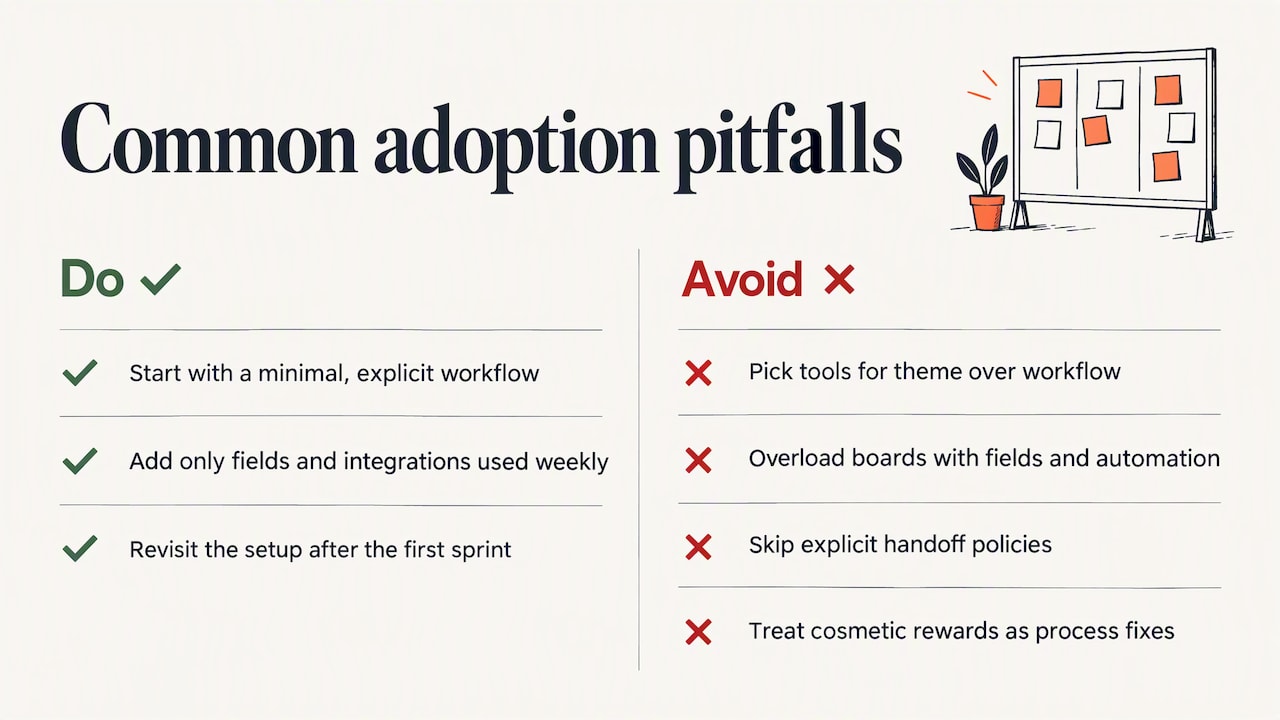
The most common failure is picking a tool for its theme rather than its workflow fit, then abandoning it within a month because the actual friction points, chat scattered elsewhere, documents in a different app, were never solved.
A second pitfall is overloading the board with custom fields and automation before the team has a stable process to automate. A board with 15 fields per task is harder to scan than a notebook, which defeats the purpose of visual management entirely.
A third issue is skipping explicit handoff policies. The ethnographic communication study found that ambiguous specs and inefficient information transfer are recurring sources of friction between disciplines, and a board alone does not fix that unless the team also agrees on what "ready for review" or "blocked" actually means.
Finally, teams sometimes treat gamified elements, like cosmetic rewards, as a substitute for real process fixes. A badge does not resolve a missing handoff signal. The fix for all of these is the same: start with a minimal, explicit workflow, add only the fields and integrations the team actually uses weekly, and revisit the setup after the first real sprint instead of guessing upfront what will matter.
Measuring engagement and productivity on the board
The most useful metrics for a small team are behavioral, not vanity numbers. Task movement rate, how often cards actually progress across the board, tells you more than total task count. A board full of cards stuck in "in progress" for weeks signals a bottleneck, not productivity.
Chat-to-task conversion is another practical measure: when a decision made in chat gets logged back onto the relevant task, context survives for whoever picks up the work next. When it does not, information quietly leaks out of the system.
Missed estimate frequency, tracked over a few sprints, shows whether a team's planning is improving or stuck. The Game Outcomes Project ties accurate estimation to better outcomes, which makes this one of the more actionable numbers a small team can watch without needing a dedicated analyst.
Finally, a simple post-mortem checklist after each milestone, even a 30-minute one, turns scattered impressions into a repeatable signal: what blocked us, what we estimated wrong, what we would change. Tracked over several milestones, that log becomes the closest thing a small team has to a performance dashboard, without requiring enterprise reporting tools.
What successful small-team adoption tends to look like
A recurring pattern among small interdisciplinary teams that adopt this kind of board successfully starts with narrowing scope before expanding it. Rather than migrating every past project into the new board at once, a team imports only the active backlog, assigns role owners, and runs one vertical slice milestone before deciding what else to bring over.
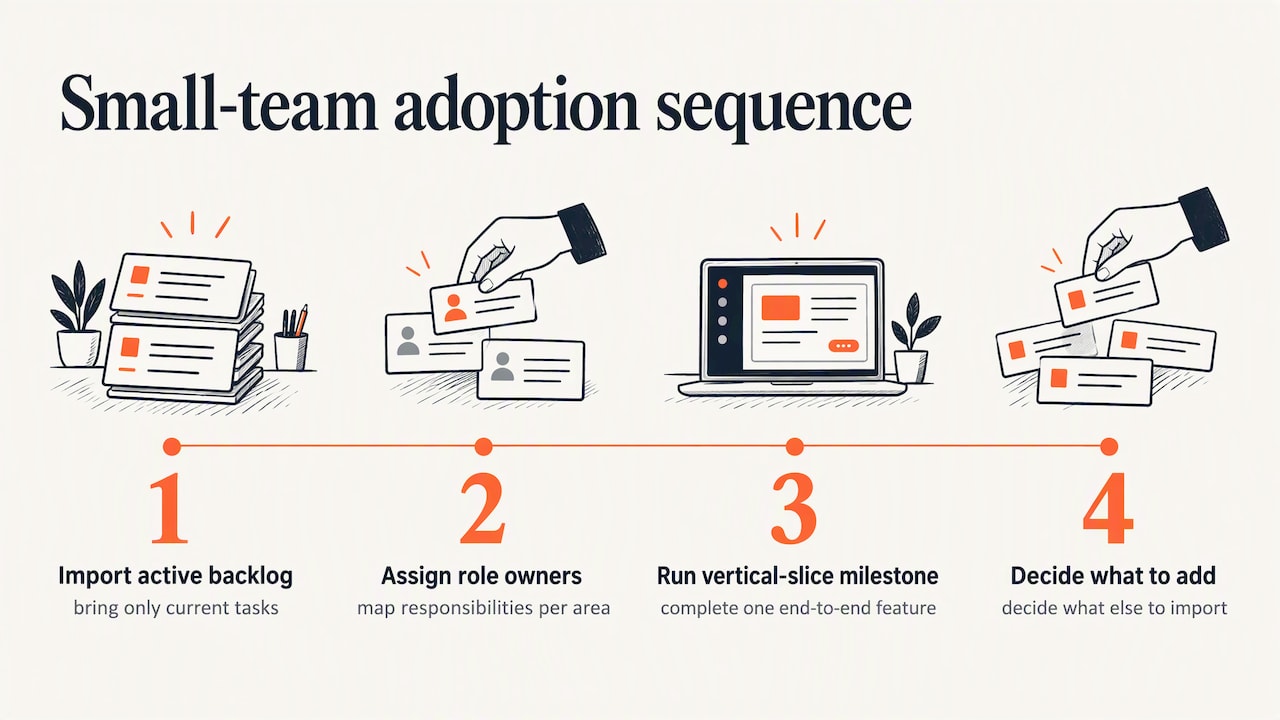
Teams that stick with the practice tend to treat the handoff signal, not the board itself, as the real deliverable of week one. Once "ready for review" or "blocked on art" means the same thing to everyone, the board becomes a record of actual decisions instead of a to-do list nobody trusts.
The teams that struggle tend to share one trait: they adopted the tool but skipped the post-mortem step, so the same estimation mistakes repeated across milestones with no mechanism to catch them. The retrospective workflow analysis of a cross-border project found exactly this gap: informal process gave teams resilience in the short term, but without visible, documented policy, problems resurfaced in testing and handoff rather than getting resolved.
The lesson scales down well: a five-person team that writes down two handoff rules and reviews them after each milestone tends to outperform a team with a flashier board and no such discipline.
Where most advice on this topic gets it backwards
Most coverage of gamified project management treats the game theme as the headline feature, when for a working studio it is closer to a nice-to-have wrapped around the actual fix: consolidation. The real gain comes from removing the seams between chat, docs, code, and tasks, not from adding points or streaks to an otherwise fragmented workflow.
The conventional advice to "just use Trello plus Discord plus Notion" undersells how much information dies in the gaps between those tools, especially for a team of five people each covering two or three roles. The Game Outcomes Project data on shared vision and estimation accuracy is really an argument for visibility, not for gamification as entertainment.
If a small team takes one thing from this, it should be to fix the handoff signal before worrying about theme, rewards, or dashboards. A clear, shared definition of "done" and "blocked" will do more for a five-person studio than any leaderboard, and it costs nothing to write down on day one.
Lauren
Try Inferno free for your indie team
If reading this made the gaps in your current setup more obvious, Inferno is free to use for indie teams of 2 to 8 and built around the exact checklist covered above: boards, chat, docs, and GitHub links in one place, with an interactive demo you can try before touching your real backlog.
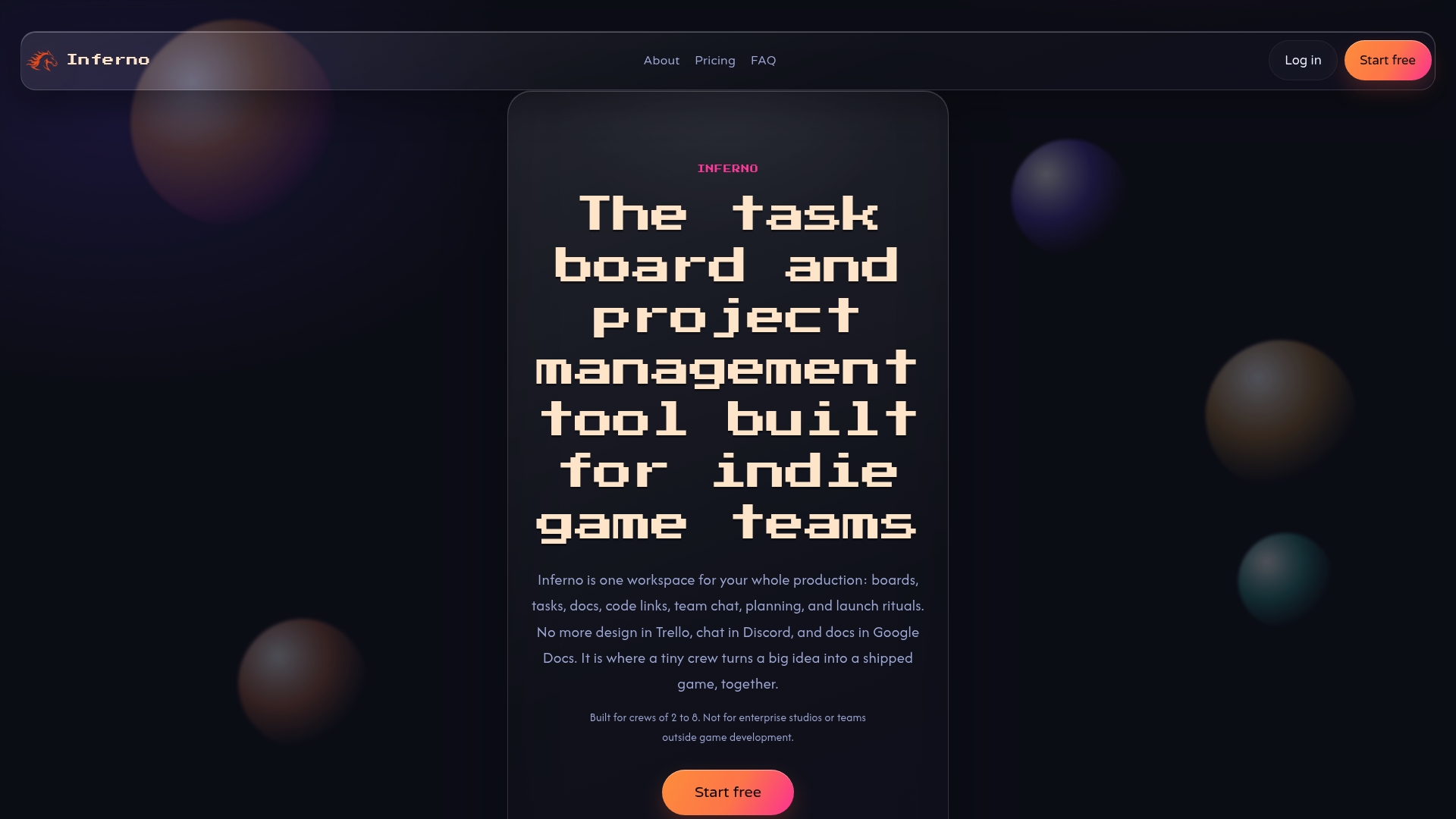
Check the free plan details or head straight to the product page to start a workspace and see whether the workflow fits before you move your team's backlog over.
FAQ
What does "gamified project management" mean for indie teams?
Here, it refers to a game themed, all in one task board that combines Kanban boards, chat, documents, and code links into a single workspace built for small studios. It is distinct from adding points or badges to a general office productivity tool.
Is a gamified board worth it for a 2 to 8 person team?
For teams this size, consolidating tools tends to reduce the handoff errors and information loss that ethnographic research identifies as common failure points in game development. A single workspace with explicit handoff signals addresses that gap more directly than adding more separate apps.
What features should a small studio prioritize first?
Start with a Kanban board that has game-specific role fields, in-app chat attached to tasks, document attachments, and code links, since these cover the handoff points most likely to break down. Calendar views and reporting matter, but they matter less in the first month than getting handoffs right.
How much does Inferno cost for an indie team?
Inferno is free for indie game development teams of 2 to 8, with no credit card required and no paid tier today. Sign-up and the interactive demo are available directly on the product page.
How do small teams measure if the board is actually working?
Useful signals include how often tasks actually move across the board, how often chat decisions get logged back onto tasks, and how often estimates are missed over several sprints. The Game Outcomes Project ties accurate estimation specifically to better project outcomes, which makes it a practical metric to track.